
As October marks the 80th anniversary of the historic Nuremberg verdicts, The Center for American and International Law (CAIL) is reflecting on the legacy of its founder, Robert G. Storey, and a collaboration helping preserve and share his story with future generations.
On October 1, 1946, the International Military Tribunal at Nuremberg delivered its final verdicts against leading Nazi officials for crimes committed during World War II. The proceedings marked a defining moment in international justice, establishing important precedents for holding individuals accountable for war crimes and crimes against humanity.
Among the American prosecution team was Robert G. Storey, who served as executive trial counsel under U.S. Supreme Court Justice Robert H. Jackson, the chief American prosecutor. Storey's experiences at Nuremberg helped shape his lifelong commitment to strengthening the rule of law through legal education and international collaboration.
In 1947, Storey founded the Southwestern Legal Foundation, now The Center for American and International Law, with a vision of bringing legal professionals together to strengthen the administration of justice. Nearly 80 years later, that vision continues to guide CAIL's work.
Preserving an Important Piece of History
For decades, CAIL preserved artifacts and historical materials documenting Storey's involvement in the Nuremberg Trials. Recognizing the significance of these materials beyond our institution, CAIL gifted the Robert G. Storey Nuremberg Justice Collection to the Dallas Holocaust and Human Rights Museum, where it could be professionally preserved and shared with a broader audience.
“Robert Storey's experiences at Nuremberg helped shape the foundation of CAIL and the work we continue today,” said Thomas (T.L.) Cubbage, president of The Center for American and International Law. “By sharing his legacy with a broader audience, we're helping people understand why the principles that guided his work 80 years ago remain just as important today and continue to influence how we educate and prepare those responsible for upholding the rule of law.”
In late 2025, the museum completed the digitization, preservation, and cataloging of the collection, helping ensure that these historically significant materials are more accessible to researchers, educators, and future generations. The collection can now be explored through the museum's online catalog. Explore the Robert G. Storey Nuremberg Justice Collection.
Bringing Storey's Legacy Back to CAIL
Although the original collection is now in the museum's care, Storey's story remains an important part of CAIL's identity. On August 27, representatives from the Dallas Holocaust and Human Rights Museum visited CAIL's education center in Plano to install a refreshed exhibit in the Hoblitzelle Hall of Flags.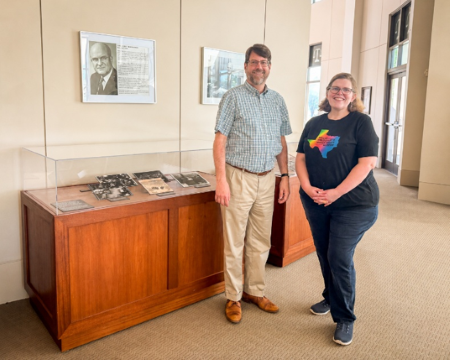
Photo: Thomas (T.L.) Cubbage, CAIL president, and Felicia Williamson, director of library and archives at the Dallas Holocaust and Human Rights Museum, stand in front of the completed display of replicas from the Robert G. Storey Nuremberg Justice Collection at CAIL's education center in Plano.
Museum staff worked with CAIL to arrange replicas of artifacts from the collection, creating a professionally curated display that highlights Storey's role at Nuremberg and its connection to the institution he founded.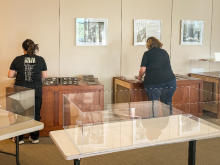
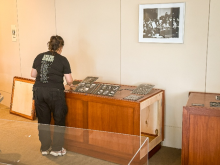
Photo: Members of the Dallas Holocaust and Human Rights Museum team install replicas from the Robert G. Storey Nuremberg Justice Collection.
The display provides a tangible connection to CAIL's founding history, allowing visitors to appreciate the experiences that inspired Storey's vision while the original artifacts benefit from the museum's specialized preservation and educational resources.
A Legacy That Continues Today
Eighty years after the Nuremberg verdicts, the principles that shaped Storey's vision remain central to CAIL's mission. Through education, professional development, and international collaboration, CAIL continues to strengthen the administration of justice and prepare legal and law enforcement professionals to uphold the rule of law in the communities they serve.
We are grateful to the Dallas Holocaust and Human Rights Museum for its care in preserving the Robert G. Storey Nuremberg Justice Collection and for helping share this important chapter of our history with a wider audience.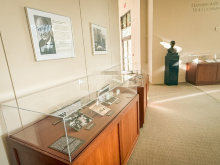
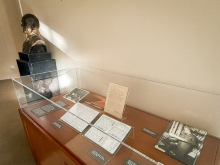
Photo: The completed display from the Robert G. Storey Nuremberg Justice Collection in CAIL's Hall of Flags.
The next time you visit CAIL for a program, meeting, or event, take a few moments to explore the Robert G. Storey Nuremberg Justice Collection display in the Hall of Flags. It's an opportunity to connect with the history that inspired our founding and the principles that continue to guide our work today.
Learn more about Robert G. Storey and CAIL's history.
###
About The Center for American and International Law - Founded in 1947, The Center for American and International Law (CAIL) is a nonprofit institution based in Plano, Texas, dedicated to advancing justice and promoting the rule of law through the professional development of legal and law enforcement practitioners worldwide. Today, CAIL's educational institutes have established internationally recognized forums and programs addressing law enforcement administration, energy law, international and comparative law, transnational arbitration, law and technology, criminal justice, and other relevant topics. Thousands of lawyers and law enforcement officers from all 50 states and 130 countries have participated in CAIL programs. www.cailaw.org
Contact
Karla Larraga, Communications Officer
(972) 244-3436 | klarraga@cailaw.org